Excerpt Documented (Scene 4 - Ending)
@Black Box 370 Jay St, Brooklyn, NY
@Black Box 370 Jay St, Brooklyn, NY
01 Overview
Informed by spatial theory, including Henri Lefebvre’s The Production of Space and Edward Soja’s concept of Thirdspace, as well as theories of embodied memory, the project proposes that the body is not anchored to a single geographic location. Instead, it exists within a fluid and layered memoryscape shaped by accumulated experiences.
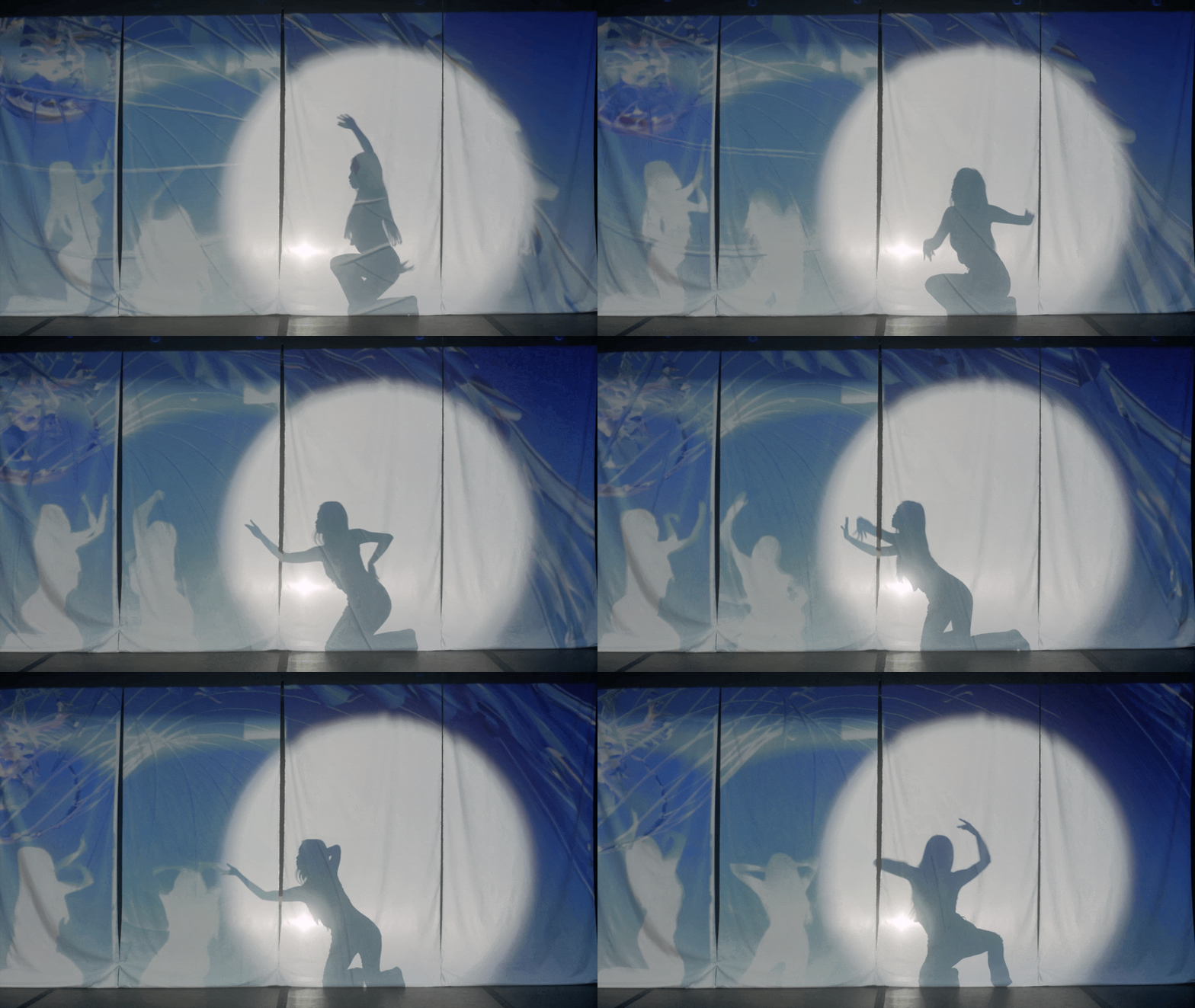
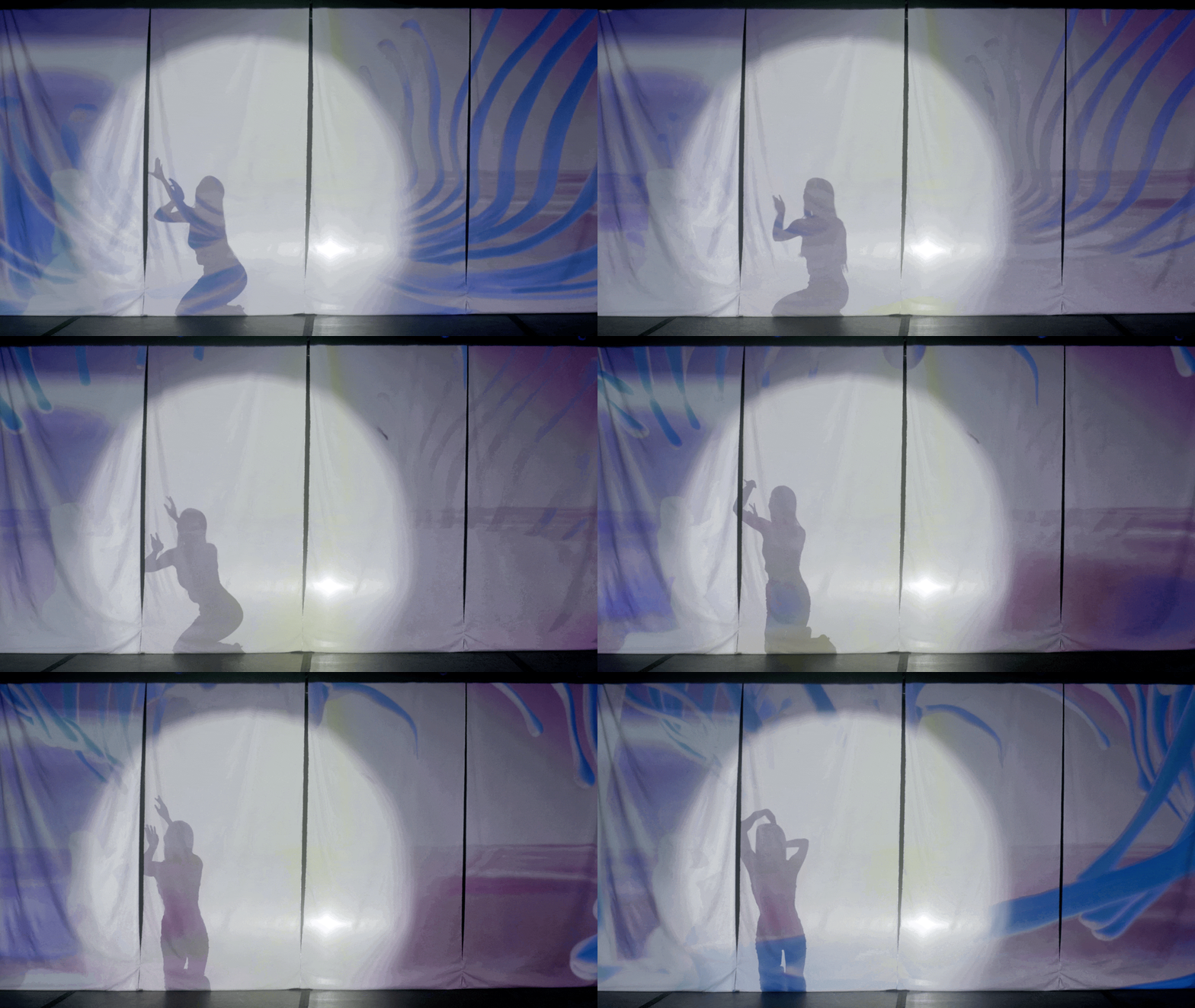
At its core, the work is structured around a recursive projection system in which live movement is continuously recorded, transformed, and reintroduced into the performance space. Past movement reappear alongside the present body, generating layered visual traces that collapse distinctions between past and present, memory and action.
Place Untitled aims to extend beyond the autobiographical to address broader narratives of migration, displacement, and belonging. The work reflects on the often invisible ways individuals carry memories and histories within their bodies as they move across borders and through time.
02 Research Process
To which space does my body truly belong?
How does memory persist within the body?
To address these, I conducted a theoretical study of spatial and memory philosophy.
How does memory persist within the body?
A. Spatial Theory:
I first examined Henri Lefebvre's The Production of Space to understand the non-traditional definition of space as something produced through social interaction and practice. His spatial triad: spatial practice, representations of space, and representational spaces provided a foundation for rethinking how space is perceived and lived.
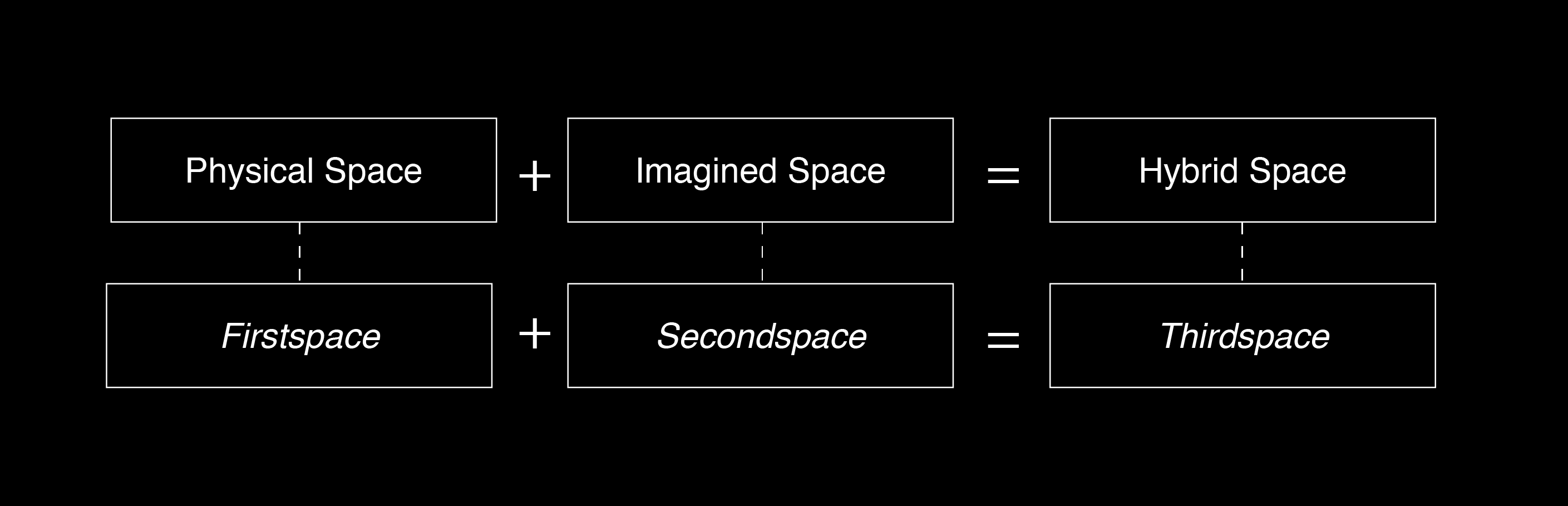 Building on this, I turned to Edward Soja's concept of Thirdspace, which reframes space as a hybrid of
the physical (Firstspace) and imagined (Secondspace). Soja's Thirdspace is a space of possibility,
where
real environments and symbolic meanings blend into a lived, emotionally charged experience.
Building on this, I turned to Edward Soja's concept of Thirdspace, which reframes space as a hybrid of
the physical (Firstspace) and imagined (Secondspace). Soja's Thirdspace is a space of possibility,
where
real environments and symbolic meanings blend into a lived, emotionally charged experience.
By grounding my research in these theories, I developed Place Untitled as a performance that constructs its own Thirdspace: one built from field-recorded sound and imagined CG visuals.
B. Embodied Memory:
Works such as Remembering: A Phenomenological Study by Edward Casey, How Socities Remember by Paul Connerton, and (Borderlands/La Frontera) by Gloria Anzaldúa helped frame memory as an embodied and migratory phenomenon. gesture.
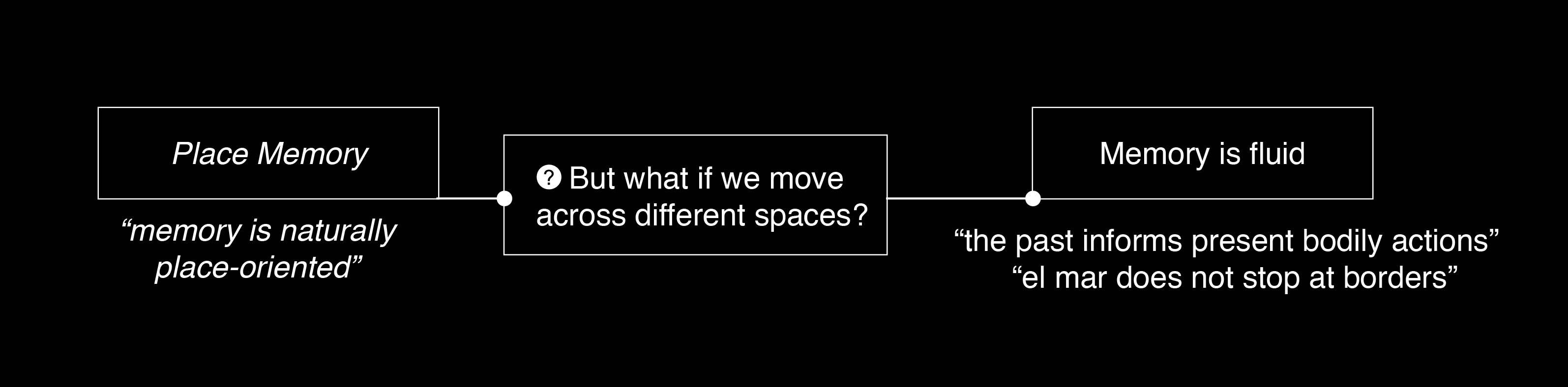
Edward Casey describes memory as inherently tied to place aand formed through our body's interaction with space. He coined the term place memory, where lived experience shapes our sense of belonging (Casey 186).
But what happens when we move across spaces?
In his theory of body memory, Casey notes that "the past informs present bodily actions" (149). Even in new environments, our bodies carry traces of previous places. Other theorists like Paul Connerton echoes this, arguing that memory is preserved through repeated gestures and rituals. Gloria Anzaldúa adds that memory transcends physical borders, "el mar does not stop at borders" (3).
Together, these ideas suggest that memory is fluid. It moves with us, resurfacing through the body's actions over time.
 Rather than asking where does my body belong?, I propose an
important new framework:
Rather than asking where does my body belong?, I propose an
important new framework:
The body belongs in a holistic memoryscape—shaped by all the spaces it has moved through.
In Place Untitled, my movement becomes a way to access and layer these memories in real time.
03 Production Process
A. Field Recording and Audio Design as
Firstspace
I captured over 100 ambient audio clips from Beijing, Hong Kong, Bangkok, and New York using handheld recorders. These included vernacular sounds (e.g., train announcements, market bargaining, temple chants) chosen for their cultural specificity and emotional resonance. These formed the texture of each city's Firstspace.
B. CG Moving Image Making as Secondspace
Using Autodesk Maya, I imagined the abstract landscape through CG image making. These landscapes are to design the emotional atmospheres of each city rather than literal depictions. It emphaszies on how each city makes me feel, rather than how it looks.
Examples include:
• A phoenix soars above Beijing, embodying my longing for something unattainable.
• Ribcage-like overpasses enclose Hong Kong, mirroring the pressure of nonstop movement.
• In Bangkok, floating jellyfish echo the city's soft stillness and spiritual ease.
• Concrete jungle represents New York, symbolizing the lost and enchanted space.
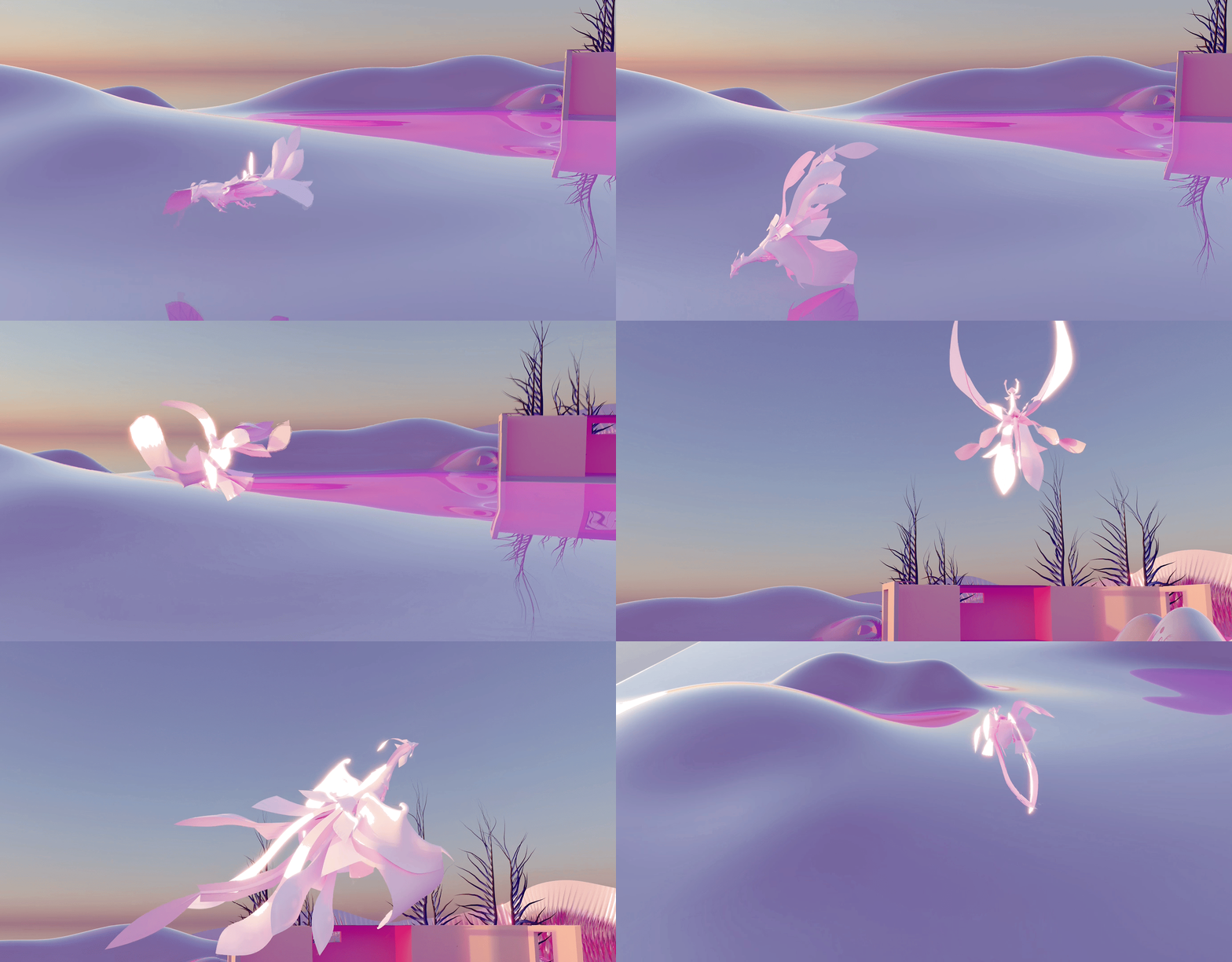
These visualizations become dreamlike expressions of Secondspace. Together with the audio as the Firstspace, they form
layered, immersive environments for four chapters of the performance. • Ribcage-like overpasses enclose Hong Kong, mirroring the pressure of nonstop movement.
• In Bangkok, floating jellyfish echo the city's soft stillness and spiritual ease.
• Concrete jungle represents New York, symbolizing the lost and enchanted space.
C. Poetry as transition for
Thirdspace
To guide the audience through the transition between each chapter or location, I wrote four original poems, delivered like flight attendant announcements. The texts deliberately avoid indicating the names of the cities. This anonymization serves to breaks the fixed geographic associations, reinforcing each city as a hybrid, reimagined space.
D. Body in
Thirdspace
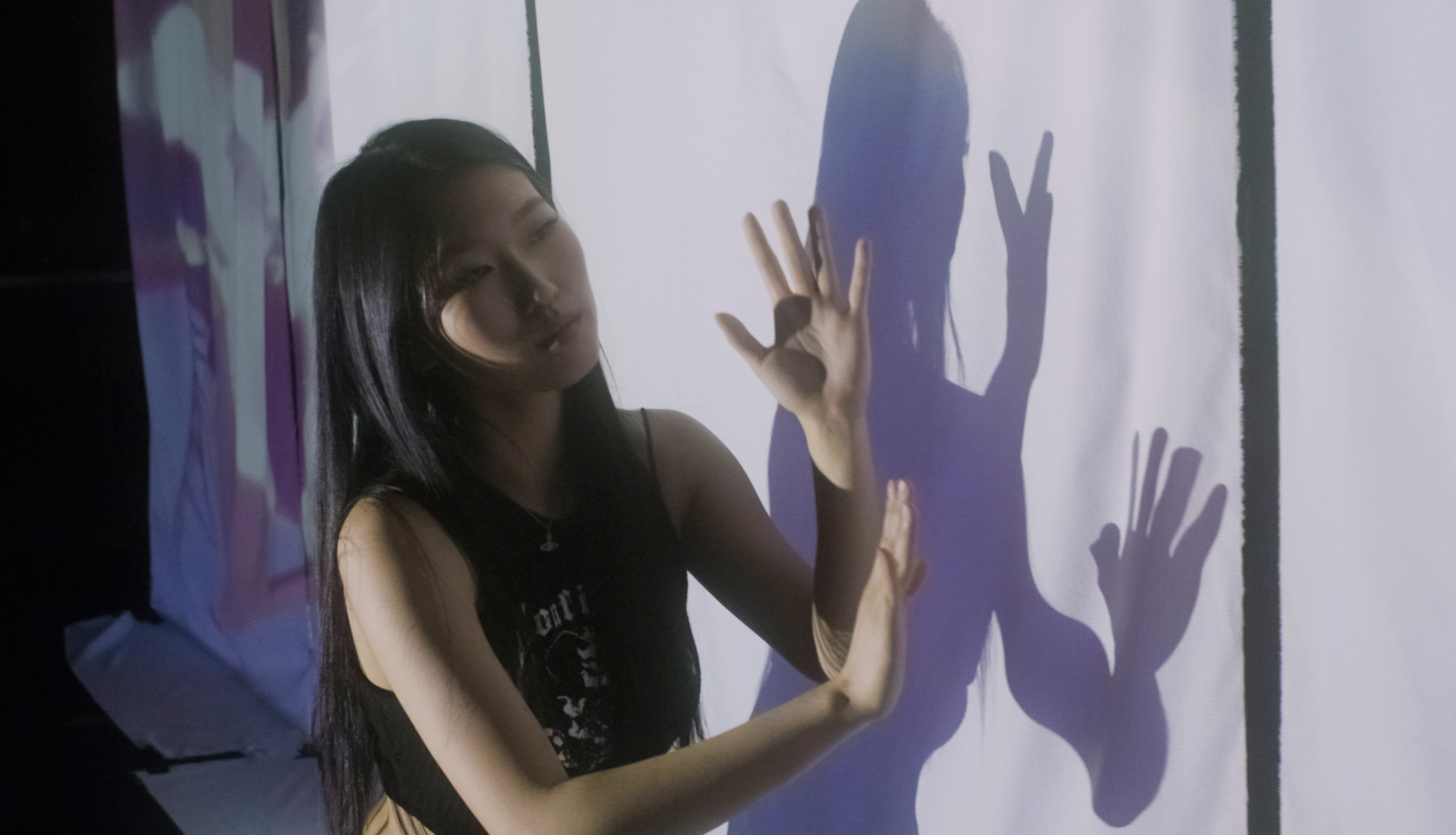
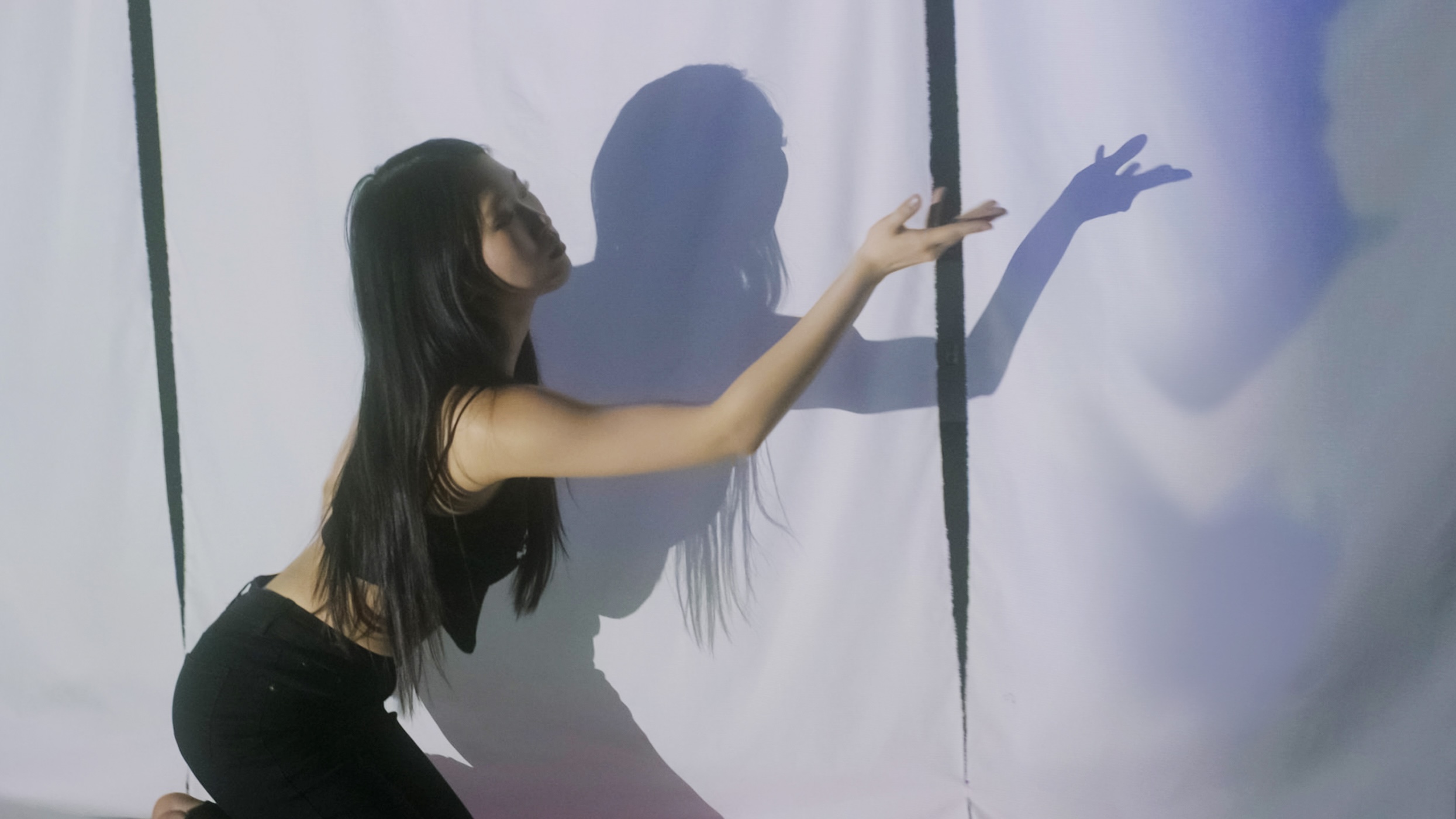
To bring these Thirdspace to the stage, I suspended four curtains side-by-side across the middle of the stage. A front projector casts the visuals onto the fabric, while a back spotlight projection creates my live silhouette as I move behind it. These curtains allow my present body to dance within imagined landscapes of the past. It constructs a space where past memories and present memories live together, where the boundaries between real and imagined blur and collapse.
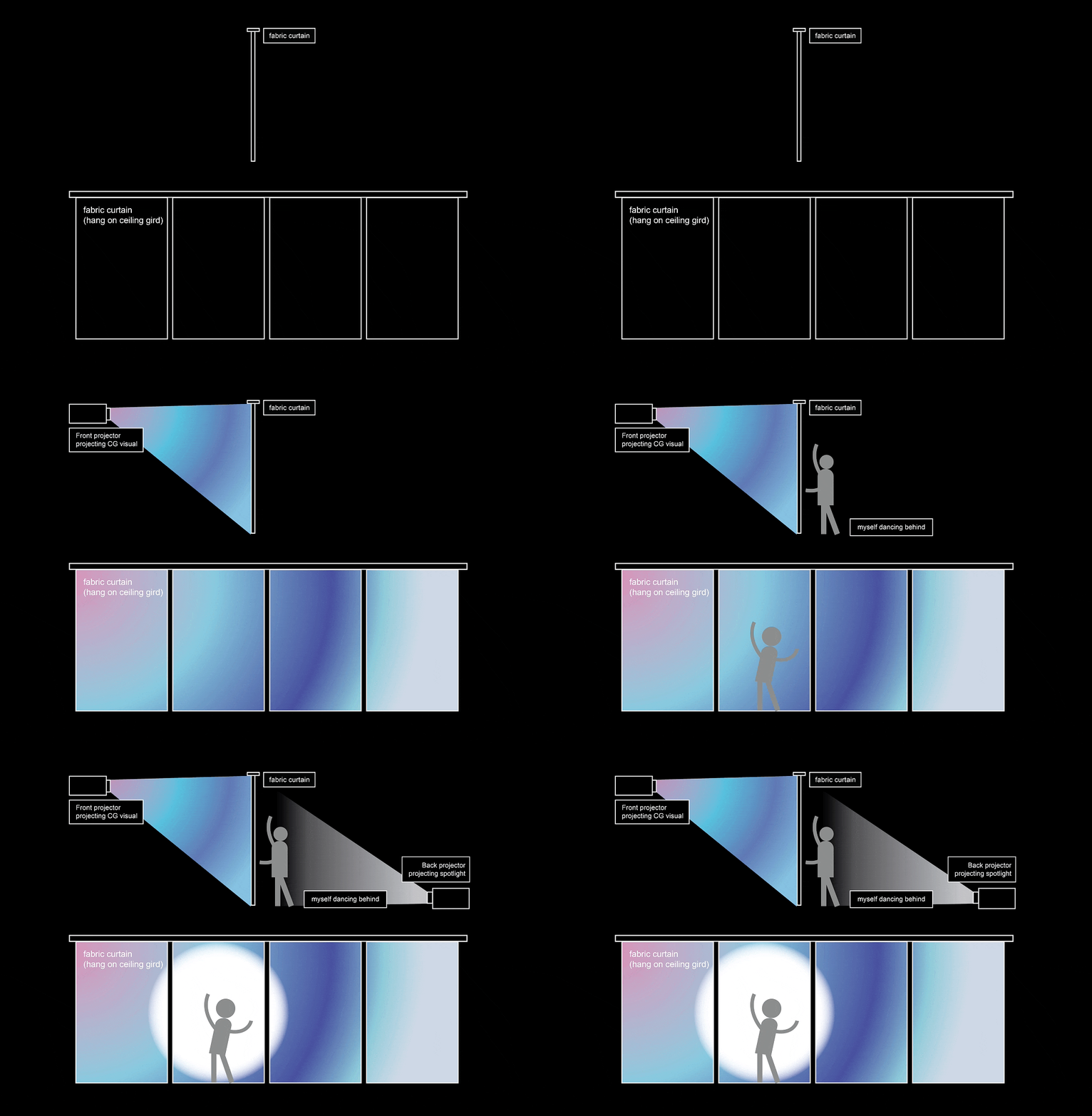
Stage Setup Breakdown
E. Real Time Tech
After the construction of space, I designed a real-time technology to record each chapter of the performance. Using TouchDesigner, I connected the computer with a webcam mounted on the ceiling in the front. The webcam records each chapter's dance live, and then processes the live recorded footage into white silhouette forms of body dancing, and stores them as video footage. These stored videos will resurface as later chapters emerge.
F. Performance in Thirdspace
Each performance is guided by improvisation, shaped by the soundscape, projected visuals, and most importantly, the memory of earlier movements. For instance, in Scene 1, I might extend my arm toward the second curtain, as if reaching for the future. That gesture is recorded. In Scene 2, the projection of that moment reappears, and I respond by completing the "holding hand" motion. This creates a v choreographic dialogue between past and present. Each performance reconfigures this interaction, allowing memory to resurface in new, unpredictable ways.
04 Behind the Scenes
06 Publications & Presentations
2026
Place Untitled, ACM TEI’26 (Conference on tangible, embedded, and embodied interaction) Art and Performance Track, Exhibitor & Performer.
Chicago, IL
2026
Place Untitled: A Recursive Performance, College Art Association (CAA) Annual
Conference,
Artistic Presets: Technology, Labor, and Innovation, Presenter.
Chicago, IL
2025
Place Untitled, Black Box Theatre, Solo Performance.
New York, NY